
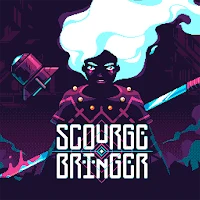
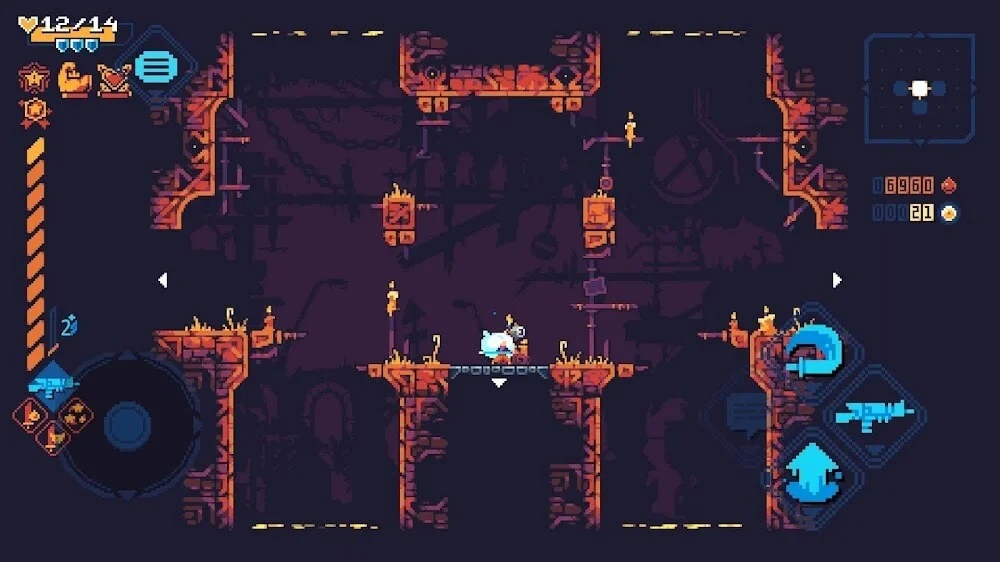
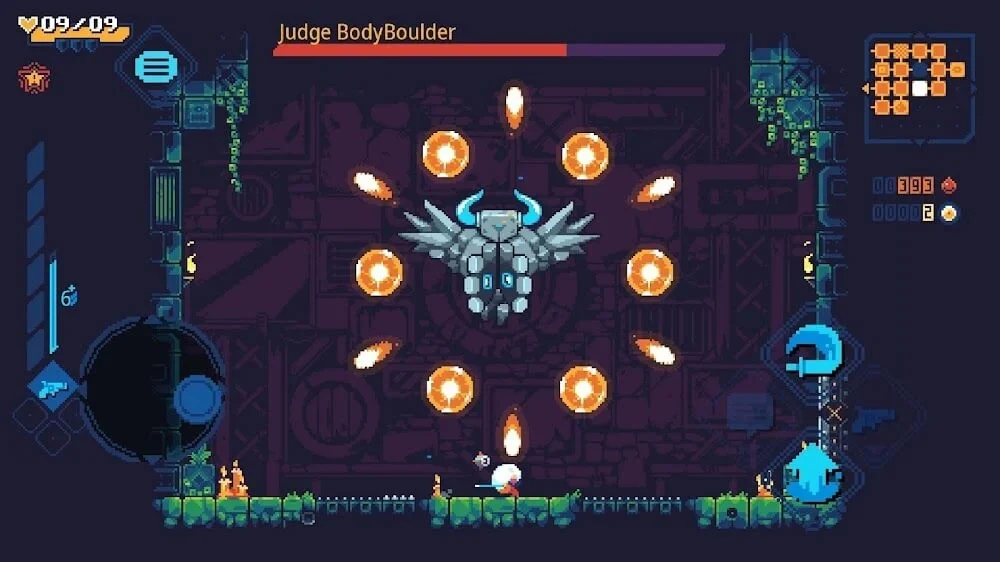
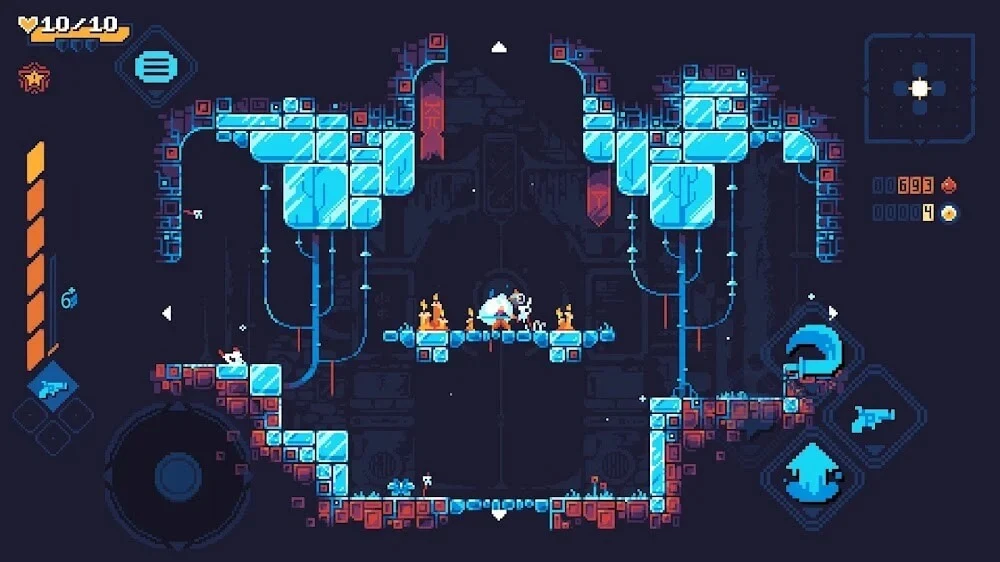
ScourgeBringer places you in control of Khyra, a warrior descending into the unexplored depths of a post-apocalyptic world. The central activity is fast platform combat: move through connected rooms, avoid traps and enemy fire, defeat opponents with close and ranged attacks, and search the changing dungeon for a path toward the truth behind the world’s destruction.
What is Khyra trying to accomplish?
Khyra enters the ScourgeBringer after a mysterious monolithic structure appears in the sky and leaves the planet in ruins. Her objective is to descend into its uncharted depths, overcome the threats inside, and uncover information connected to the disaster. The setting combines an unknown world, ancient defenses, and a dangerous succession of rooms rather than a conventional open landscape.
How does movement and combat work?
Movement is built around constant action. Khyra can jump, perform a double-jump attack, dash, climb walls, and stay close to surrounding surfaces while attacking. The source also describes flick-based phone controls for actions such as dashing and slashing. These abilities let you move around enemies and platforms instead of relying only on attacks from the ground.
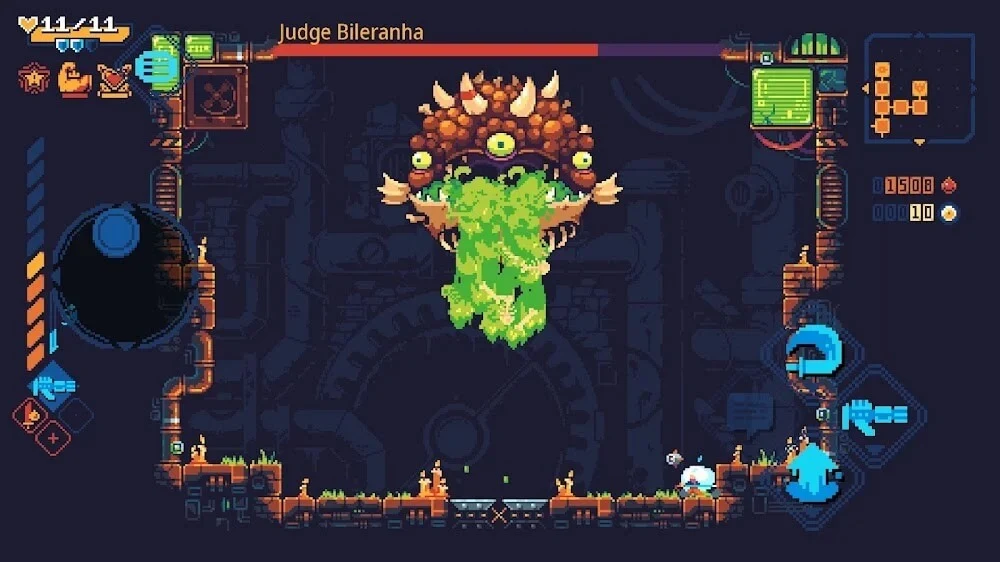
Khyra’s basic sword attack deals damage, while a heavier slash can temporarily stun enemies. Defeated enemies help charge the ammunition meter for her gun, allowing her to fire bullets when a larger opponent needs to be weakened or when a difficult position needs to be cleared. Sword and shooting actions can be aimed in different directions, supporting attacks while Khyra is moving through the room.
What are the dungeon rooms like?
The dungeon is divided into small combat rooms connected by single-screen passages. Its composition changes through random elements, so a new attempt can contain different encounters, treasures, and hazards. This roguelike structure means that exploration is not simply a matter of memorizing one permanent route. A room may contain a valuable discovery or a trap that punishes careless movement.
Some areas also contain trading points where blood collected from enemies can be exchanged for temporary upgrades. An Altar of Blood gives Khyra a choice of blessings that affect the current run. These short-term decisions sit alongside longer-term progression, giving each descent both immediate rewards and a reason to continue improving after failure.
How does progression continue after a failed run?
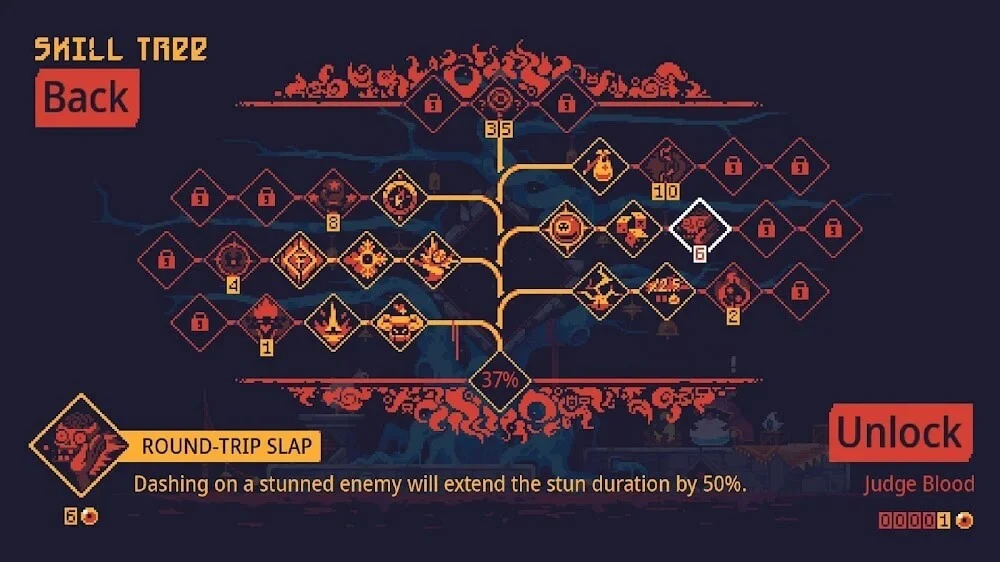
Bosses and minibosses are known as Judges. Defeating them provides Judge Blood, which remains available after death and can be used in the central area to improve core statistics permanently or unlock additional aspects of Khyra’s development. The skill tree therefore becomes stronger over repeated attempts, even when a particular dungeon run ends.
This progression works with the changing map rather than replacing it. Temporary blessings and upgrades help shape an individual attempt, while Judge Blood and the skill tree provide lasting development across attempts. The result is a structure in which failure does not erase every form of progress, although the source does not specify every skill-tree branch or upgrade effect.
How should you handle traps and enemy fire?
Room awareness is important because movement routes can contain both environmental hazards and incoming projectiles. Spike traps briefly expose their tips before extending fully, giving Khyra a moment to move away. Enemy bullets can cross the room quickly, while some slower projectiles remain dangerous when several are present at once. Checking the room layout for safer positions can help when direct movement would expose Khyra to fire.
Enemy behavior also provides useful information before an attack. The source gives the Devil as an example: when it notices Khyra, an exclamation mark appears above it before it fires a three-shot salvo. You can respond by moving in quickly with a Smash to stagger it or by allowing the attack and then taking cover. Learning these signals helps distinguish when to attack immediately and when to wait for a safer opening.
Which enemies should be dealt with first?
Target selection matters in rooms containing several threats. Enemies that can attack from a distance or create additional hazards may deserve attention before opponents that are less urgent. Fall-bots, for example, can become projectiles when they drop and then split into two more after impact, while Bouncy-Jellos create slow projectiles that can make the room harder to navigate if too many remain active.
Groups containing Alpha Devils require similar prioritization because they can open fire from opposite sides of a room while smaller enemies occupy your attention. Deciding which threat to remove before the room becomes crowded is part of the game’s fast decision-making. The later Realms introduce more aggressive enemies, making observation and positioning increasingly important during a run.
What kind of game structure does ScourgeBringer offer?
ScourgeBringer combines action-platform movement with roguelite repetition and role-playing progression. Each attempt asks you to move quickly, react to attacks, and adapt to a dungeon layout that can change. Combat rewards use of the sword, gun, dash, wall movement, and aerial positioning, while blood, blessings, and the skill tree provide different layers of advancement.
The source also describes accessibility options that can adjust the experience for players who do not want every run to be equally demanding. Details of those options are not fully specified, but they are presented as part of the available settings. The Android version is described as playable with phone controls, with controller support also mentioned in a player comment.