

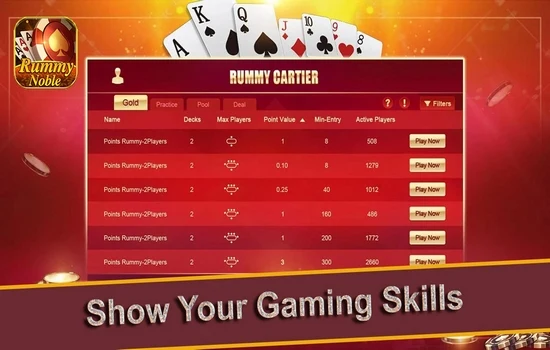
Rummy Noble is a card game centered on rummy mini-games where players arrange their cards, assess opponents’ hands, and make decisions shaped by both strategy and chance. The game combines classic rummy rules with social communication features, profile customization, and a modern 3D presentation.
What is the main objective in Rummy Noble?
The central task is to form valid sets and sequences from the cards dealt to you and use them to complete a strong hand. A sequence consists of three or more consecutive cards from the same suit. A set consists of three or four cards with the same rank but different suits. Players must evaluate their own cards while trying to infer which combinations other players may be building.
Winning is not described as relying on luck alone. Each round asks players to think about which cards to keep, which cards to play, and how an opponent’s choices may affect the result. Card draws still introduce uncertainty, so a favorable or unfavorable draw can change the direction of a match.
How do strategy and luck work together?
Rummy Noble presents every round as a balance between deliberate decisions and unpredictable card draws. Planning combinations and anticipating an opponent’s moves can improve a hand, but the next card may alter the options available. This combination gives experienced players room to refine their decisions while keeping individual rounds uncertain.
The rules are presented as accessible to newcomers, while the strategic depth gives more experienced card-game players opportunities to improve. The source describes matches as suitable for different experience levels, with each game providing a new combination of cards and decisions to consider.
What should a player understand about sequences and Jokers?
A pure sequence is a consecutive group of cards from the same suit made without a Joker. The supplied strategy guidance identifies creating one early as a priority because a hand cannot be declared without a pure sequence, even when its other cards form valid combinations. Understanding this requirement provides a foundation for organizing the rest of the hand.
Jokers can substitute for missing cards in a set or sequence, but the guidance recommends using them carefully rather than placing them in a pure sequence. When several Jokers are available, distributing them across different combinations may help complete more than one set or sequence.
How can players read an opponent’s decisions?
Discarded and selected cards can provide clues about the combinations an opponent may be attempting to build. For example, taking a card that was discarded may suggest that it fits a developing set or sequence. Watching these choices can help a player decide which cards are less useful to offer and which cards may be worth retaining.
The strategy material also advises caution with high-value cards such as Kings, Queens, Jacks, and Aces. If these cards are not helping to form a set or sequence, discarding them earlier can reduce the points held in the hand if another player declares first. Middle-range cards may be more useful when building consecutive sequences.
What communication features are available?
Players can interact during games through quick voice chat and emoticons. Outside matches, channels allow players to share tips and favorite games. These features support communication between participants without changing the card-focused objective of forming valid combinations.
What presentation and customization features are described?
Rummy Noble is described as using attractive 3D graphics and a user-friendly interface. Players can customize their profiles with different royal avatars, giving their in-game identity a personalized appearance. The game is categorized as a card title and is presented as a modern take on classic rummy gameplay.
Can players compete with people they know?
The source describes the game as suitable for sharing with friends and family, whether the occasion is a casual gathering or a more competitive challenge. It also refers to interaction with players from around the world. These social elements accompany the rummy matches, where participants can compare decisions, react to unexpected card draws, and communicate through the available tools.