
Pocket God is a casual simulation game in which you take the role of a god overseeing a primitive island and its inhabitants, the Pygmies. The central activity is interacting with islanders and using divine powers to change what happens to them, whether you choose helpful or destructive actions. Alongside this open-ended island play, the game includes episode-based challenges, collectible gods, battles, and mini-games. Its straightforward touch controls let you select an islander and direct an action, making it suited to players who want short activities as well as a mix of different game modes.
What can you do as the island’s ruler?
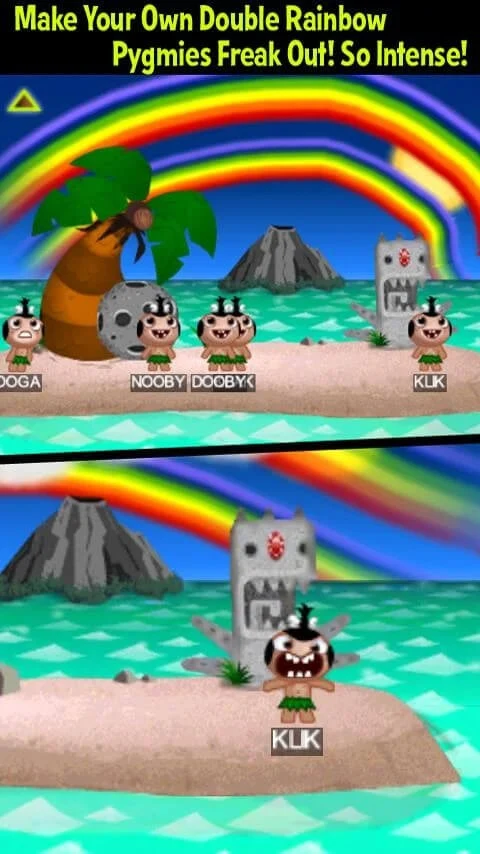
The island is presented as a small, familiar setting with features such as coconuts and hills. You can touch a villager to make them fish or use other interactions to direct their activities. The game frames these choices as part of being the island’s ruler: you may act benevolently, entertain yourself by manipulating island life, or bring danger to the inhabitants. This gives the central simulation a playful, deliberately exaggerated tone rather than a single fixed objective.
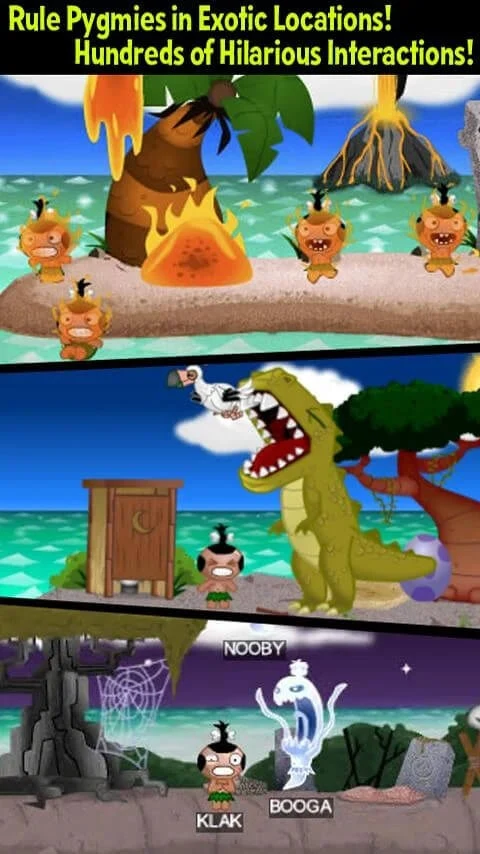
Divine actions are one way to change the scene. The supplied game information describes powers such as altering gravity, lifting islanders, and striking them with lightning; an in-game help menu is identified as the place where powers are demonstrated. The source also mentions disasters and monster invasions as ways the island can be disrupted. Players who prefer a specific task can turn to the episode challenges instead of simply experimenting with island interactions.
How do episodes and challenges work?
The challenge mode is organized into episodes, with 40 different challenges described for each episode. Tasks vary by episode, and one stated objective is to unlock at least four gods. This structure gives players goals to pursue while they explore the game’s different activities. The supplied description does not specify how long an episode takes or confirm which episodes are available in a particular version, so the episode count should not be treated as a guarantee of current content.
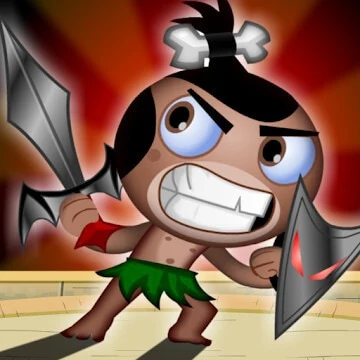
Progress also involves collecting different goods and taking them to an arena to begin battles. The game describes collecting a variety of gods so players can experiment with different powers and try to become the last survivor. In the War of the Gods, the source lists two match types, called “real” and “lever,” and describes taking down an opponent through a rock-paper-style contest. These battles add a competitive objective to the island simulation, separate from the smaller challenge tasks.
What kinds of mini-games are included?
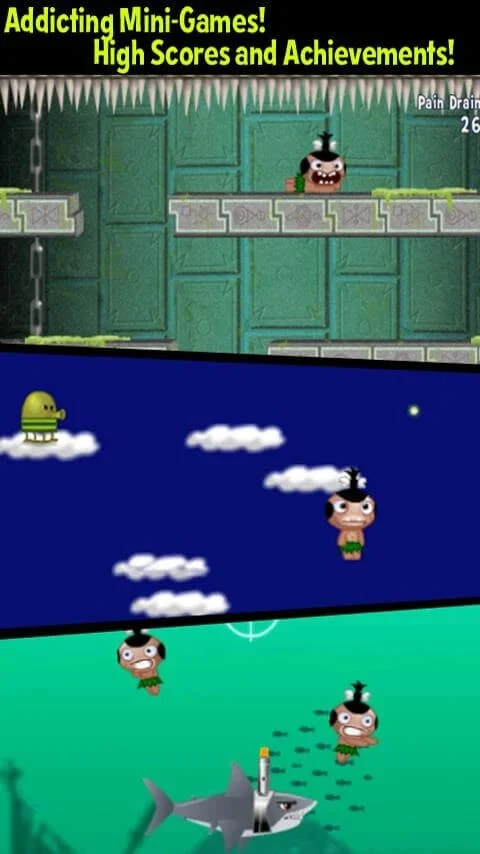
Pocket God includes activities beyond managing the island and completing episode tasks. Bowling and hurricane attacks are among the examples named in the game description. Player comments also mention a Doodle Jump-like game and other mini-games, but do not provide a complete list. These diversions make the experience a collection of different short activities rather than a simulation focused only on issuing commands to villagers.
One player comment describes a leveling system that rewards actions such as drawing rainbows or playing games. The same comment characterizes the game as something to pick up for a few minutes at a time, rather than a continuous session lasting many hours. That is a player’s account, not a stated time limit: the useful distinction is that the source describes both quick interactions and larger episode challenges, so players can choose between casual experimentation and working toward objectives.
Are there social or achievement features?
The supplied description mentions a chat room where players can view achievement rankings. It also names OpenFeint as a place for notifications about game information or battles. These features are presented as ways to see rankings and receive notices, rather than as requirements for the main island activities. The source does not explain whether these services remain available, so their current operation cannot be confirmed from the supplied information.
Player comments offer differing impressions of the game’s progression and content, including one report that updates had stopped at episode 40 on Kindle Fire. The main description, meanwhile, presents the game as episodic and says mini-games are added over time. Since those accounts do not establish the current update schedule or content for every device, players should treat them as descriptions from the supplied material, not a promise of ongoing additions.
Who might find Pocket God a good fit?
The game may suit someone looking for a light simulation built around direct touch interactions, comic island scenarios, and a variety of short diversions. Its challenges, gods, and arena battles offer more defined goals for players who want progression alongside open-ended play. People seeking one continuous, story-led activity may find the source less informative: it emphasizes a changing set of island interactions, mini-games, and episode tasks, rather than describing a single extended storyline.
Overall, Pocket God combines control of island inhabitants with divine powers, episodic objectives, collectibles, battles, and mini-games. The supplied information gives examples of its activities but does not confirm the current availability of every episode or online feature. Those details are relevant for anyone deciding whether the game’s mix of casual experimentation and challenge-based play matches what they want.