

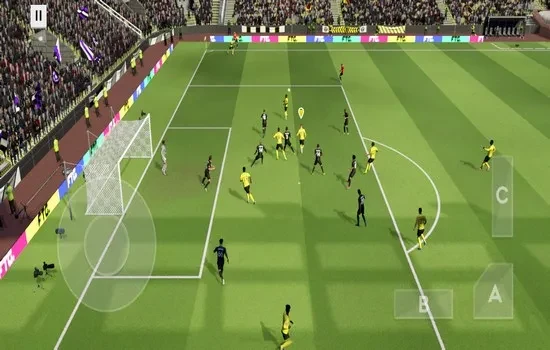
DLS 2019 is a football game in which you build and manage a team, then control its players during matches. Alongside competing in leagues and cup challenges, you can train your squad, choose formations and tactics, and customize elements of your club.
What is the player's objective?
The central aim is to develop a team that can compete against other clubs and win championships. You assemble a roster, arrange training to improve the squad, and make decisions about formations and tactics. Match results can unlock resources for team growth, according to the game's description, giving you ways to continue developing the club as you compete.
The game combines management decisions with direct control on the field. Rather than limiting your involvement to selected attacking moments, you control your players during both offense and defense. Match time is described as moving faster than real time, while retaining the match's on-field action.
How do matches and controls work?
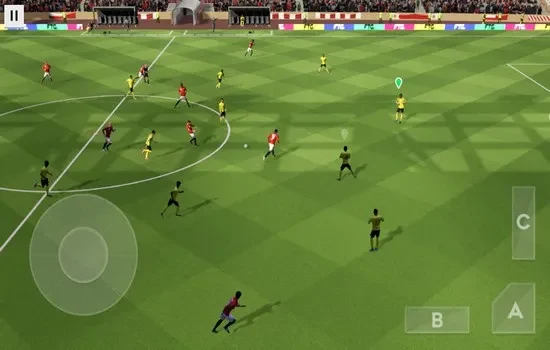
During play, a virtual joystick at the lower left moves your active player up, down, left, or right. Three buttons on the opposite side provide the other match actions, with their functions changing between attack and defense.
On offense, A is used for a long pass or goal attempt, B for a short pass or shot, and C for a floater. On defense, A makes an aggressive tackle or challenge, B makes an ordinary tackle, and C switches the controlled player. The source describes these as the basic match controls; it does not provide further button combinations.
What competition modes are available?
The game description identifies league tournaments and cup challenges as competitive formats. Its lobby separates single-player and multiplayer options, and also includes an event mode. These are listed as modes on the lobby screen; the available source does not explain the rules or structure of individual events.
How can you develop and customize your team?
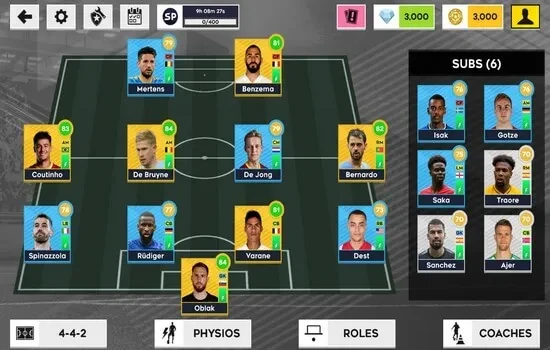
You can choose players for your roster, set team strategies, and arrange training to improve the squad. Training is available from My Club on the main menu: open that section and select Training to practice both offensive and defensive play. This gives new players and returning players a place to become familiar with the on-field controls.
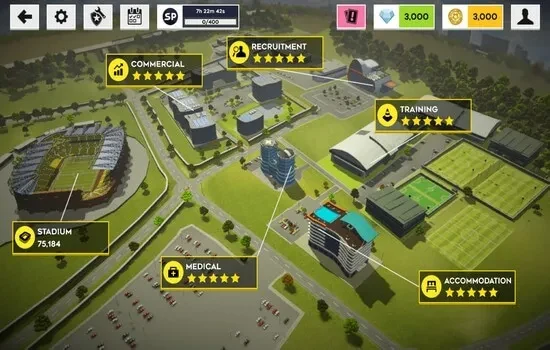
Team customization includes changing the club logo and jerseys, as well as upgrading facilities. Facility improvements are described as supporting training efficiency. The source also describes earning resources through successful matches and using in-game currency for customization, roster development, and stadium facilities; it does not specify the cost of individual options.
How does captain selection work?
When choosing a captain, the game presents five options, and you select one. The supplied guidance recommends matching the choice to your preferred approach: a forward suits an attacking style, while a defender or goalkeeper can suit a defensive approach. This is a limited choice, so the selection is made from the five offered candidates.
What should players know about the clubs and roster?
The source describes the game as featuring real-life players redistributed among fictional clubs. As a result, players who are rivals outside the game may appear on the same club roster. This is part of the game's described team setup, rather than an indication that the fictional clubs correspond to real-world teams.
For new players, the source says that completing the first match earns 1,000 coins regardless of whether the result is a win, loss, or draw. It distinguishes this from returning players, who do not receive that particular first-game reward.
What settings and presentation changes are described?
DLS 2019's settings include graphics-quality choices of low, medium, high, and very high, along with frame-rate options of Auto, 30 FPS, and 60 FPS. The description says the frame-rate limit cannot be removed and notes that graphics quality does not make a significant difference to gameplay. It also lists troubleshooting choices called No Override, OpenGL ES 2 Limitations, and OpenGL ES 3 Limitations.
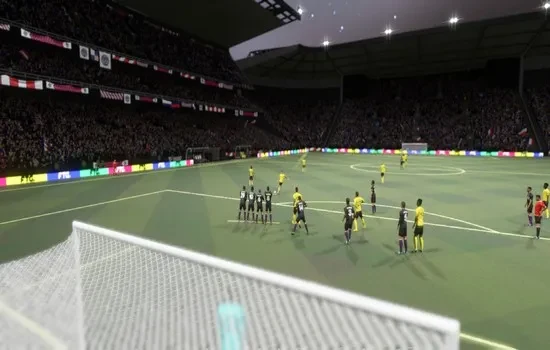
The source describes changes to the ball physics compared with the previous game, including forward rotation on headers or shots. It also notes a change to the ball model. These are presented as differences from an earlier release, not as separate modes or player settings.
Replay controls are described as having a revised layout. The listed controls include switching the player, ball, or view, along with rewind, fast-forward, and a combined play, pause, and slow-motion button. The earlier timeline control is described as removed.