

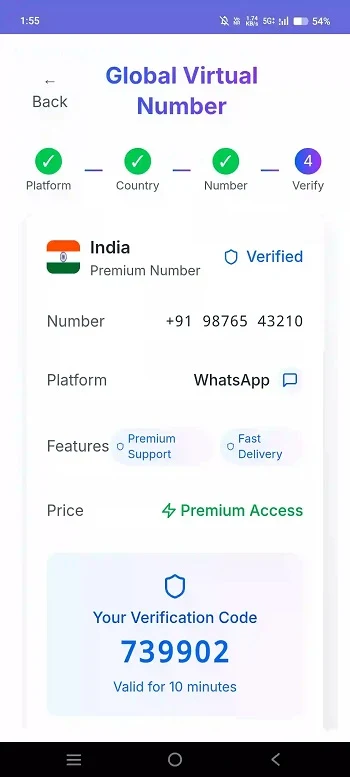
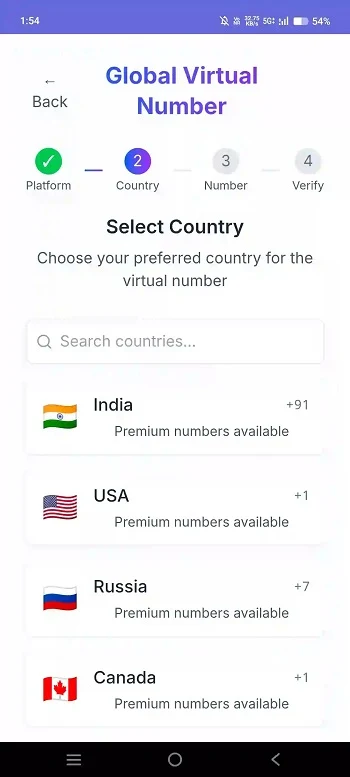
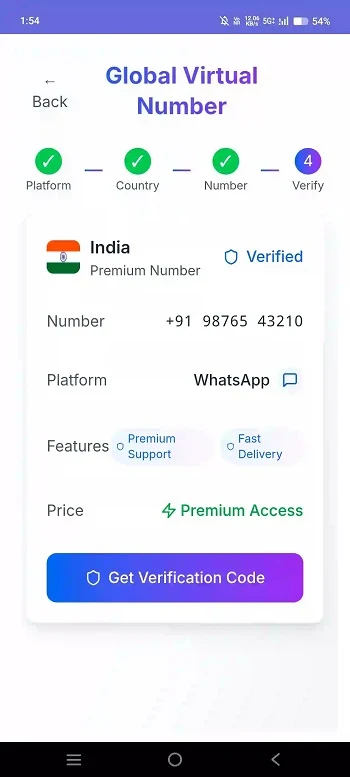
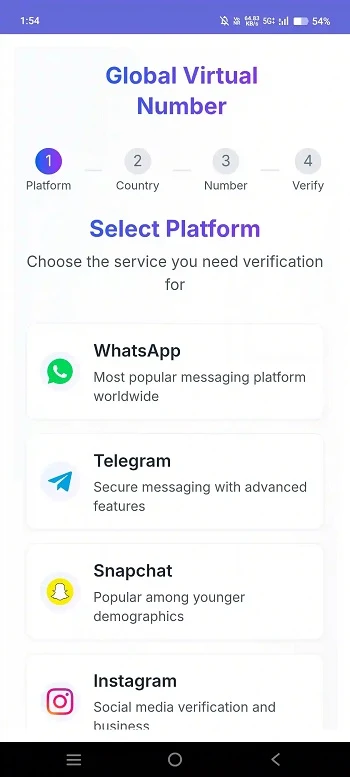
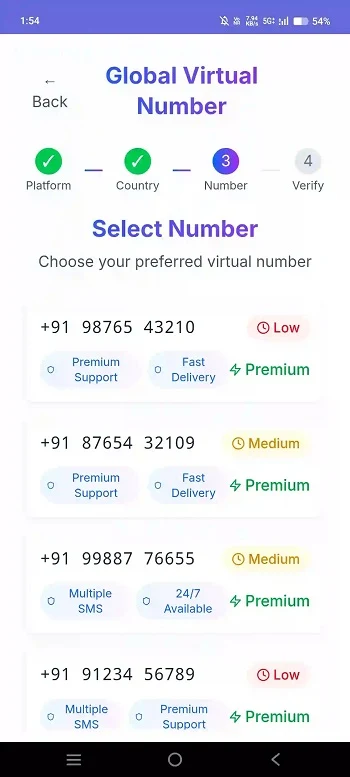
Global OTP Mod is an Android tool for generating temporary phone numbers and receiving one-time passwords for account registration or login. The supplied description presents it as a way to use a disposable number with services such as WhatsApp, Facebook, Google, and other platforms instead of entering a personal phone number. Its main workflow centers on choosing a supported country, creating a temporary number, and using that number when a service requests an OTP.
Creating a temporary number
The app documents virtual numbers from multiple countries, specifically naming the United States, the United Kingdom, India, and Canada. This country selection is intended to give users several number options when a verification service requires a phone number. The description does not identify every available country or state that every external service will accept every number, so availability and acceptance may depend on the selected service.
According to the supplied information, users can create temporary numbers for different verification purposes and use more than one number when working with multiple accounts. The description also says that the app operates without a physical SIM card. It presents the numbers as disposable and separate from a user's personal contact details, but it does not explain how long individual numbers remain available or how number ownership is managed after use.
Receiving OTP messages
After a temporary number has been used for a supported verification request, Global OTP Mod is described as receiving the resulting OTP. The listed function is real-time OTP reception, while the wider description also refers to one-time passwords used during login sessions or transactions. These references indicate that the app is intended to provide access to verification codes associated with the temporary numbers it creates.
The source also describes OTP generation as part of an authentication workflow and says that codes are time-sensitive and single-use. Elsewhere, it states that the app can generate OTPs locally after setup and synchronization. Because the source discusses both temporary-number message reception and locally generated authentication codes, these should be understood as documented aspects of the product description rather than as a detailed explanation of one unified process. The supplied information does not specify which services support each method.
Controls for different accounts
Global OTP Mod is described as supporting multiple accounts and allowing users to handle verification for several services. This is relevant for people who need separate numbers or codes for more than one registration or login. The source does not provide a numerical limit, a list of compatible platforms beyond its examples, or details about how accounts and numbers are organized inside the app.
The interface is characterized as simple and easy to navigate. The documented basic sequence is to open the app, select a country, and create a number. No technical knowledge is presented as necessary for that process. The description does not identify specific buttons, menus, or screen layouts, so the article cannot give more detailed navigation instructions.
Privacy and access settings
The stated purpose of using temporary numbers is to avoid sharing a personal phone number with every service. The source links this separation with reduced exposure to unwanted calls or marketing messages, but it does not provide independent testing or a technical security guarantee. It also recommends using a biometric or PIN lock to restrict access to the app and keeping backup copies of OTP keys in case a device is lost or reset. These are described as available or recommended controls; the source does not explain their exact setup steps.
Connectivity and documented updates
The description says that the app works online and does not require a physical SIM. It also states that an internet connection is needed for initial setup and synchronization, while OTP generation can typically continue offline after configuration. The source does not clarify whether receiving messages on temporary numbers remains possible without connectivity, so offline behavior should not be assumed for every function.
The supplied update notes mention an upgraded encryption method, a streamlined design, reduced OTP generation time, bug fixes, OTP-generation or transaction alerts, and additional language support. These notes describe claimed changes rather than independently verified test results. The provided product information identifies version 1.0, but it does not state an Android minimum version or provide a complete compatibility list.